

The International Conference on Complex and Differential Geometry was held in Trieste, Italy in May, honoring the scientific contributions of Claude LeBrun.
Over 100 participants attended from five continents and featured researchers of the highest calibur including a Nobel Prize laureate, a member of the U.S. National Academy of Sciences, numerous AMS Fellows, and recipients of the Veblen Prize in Geometry and of the Alexandre Joannides Prize de l’Académie des Sciences in France.
The conference was organized in partnership with the Clay Mathematics Institute and the International Centre for Theoretical Physics.
Congratulations to Claude for this well deserved recognition!
Thesis Defense - Dashen Yan, June 23, 2026 10:30am
Doctoral Defense Announcement
Z/2-harmonic 1-forms and applications to special holonomy by Dashen Yan
This thesis concerns multivalued sections arising from gauge theory and their applications to special holonomy, in particular to Calabi–Yau 3-folds. The first part of the thesis studies non-degenerate Z/2-harmonic functions and 1-forms. We use a variant of ellipsoidal coordinates on Rn to construct a family of non-degenerate Z/2-harmonic functions on Rn, n ≥ 3. The branching set of these examples is a codimension-2 ellipsoid, giving the first known family of non-degenerate Z/2-harmonic 1-forms on Rn with compact branching sets. We also develop a gluing construction for non-degenerate Z/2-harmonic 1-forms on compact manifolds, in which local non-degenerate Z/2-harmonic models on Rn are glued into the Morse zeros of an ordinary harmonic 1-form. As aconsequence, we show that every compact oriented manifold Mn, n ≥ 3, with first Betti number b1(M) > 0, admits a family of non-degenerate Z/2harmonic 1-forms. This resolves a folklore conjecture. We also discuss several possible applications to special holonomy, especially to G2-geometry. The second part of the thesis studies a dimensional reduction of Donaldson’s adiabatic limit program for G2-manifolds with coassociative fibrations. In this reduced setting, one considers a Calabi–Yau 3-fold equipped with a holomorphic fibration over a two-dimensional base. We construct Calabi–Yau metrics on certain hypersurfaces in C4 from branched harmonic k-fold covers of C in T∗C, which may be viewed as a linear analogue of the dimensionally reduced adiabatic data. The resulting Calabi–Yau manifolds are complete and non-compact, and admit the tangent cone C2/Zk × C at infinity.
We are pleased to inform you that the Mathematics Department’s email server has been successfully restored and is now fully operational.
We appreciate the prompt assistance provided by the University Information Technology team and Stony Brook IT in resolving the issue. Thank you for your patience and understanding during the service disruption.
If you continue to experience any issues with email access, please contact the IT support team for further assistance.
Issued: June 18, 2026
We regret to inform you that the Mathematics Department’s email server is currently experiencing a service outage due to a recent security incident.
Our university’s Information Technology (IT) Department, in coordination with Stony Brook IT, is actively working to investigate and resolve the issue as quickly as possible. At this time, access to departmental email services may be unavailable or intermittent.
We apologize for any inconvenience this disruption may cause and appreciate your patience and understanding while restoration efforts are underway.
Updates will be provided as new information becomes available.
Issued: June 18, 2026
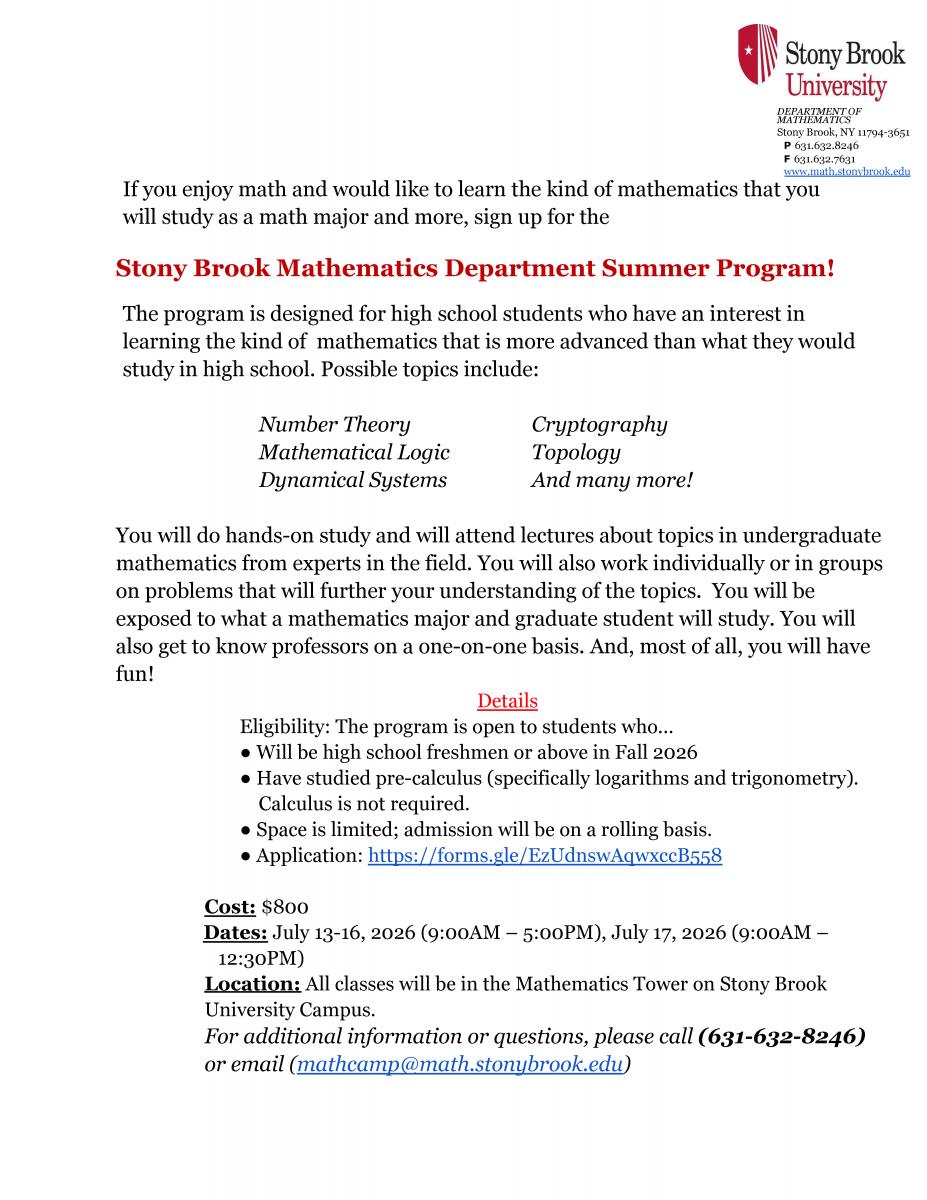
If you enjoy math and would like to learn the kind of mathematics that you will study as a math major and more, sign up for the Summer Program!

The program is designed for high school students who have an interest in learning the kind of mathematics that is more advanced than what they would study in high school. Possible topics include:
Number Theory Cryptography
Mathematical Logic Topology
Dynamical Systems And many more
Search for "Mathematics Stony Brook" on YouTube to find the channel and watch live.
Thesis Defense - Shrijan Gosh, May 7, 2026 11:00am
We will discuss the moduli space of genus 0 stable maps to a low degree hypersurface X inside an Orthogonal Grassmannian OG(k,n). In particular we show that the space of lines in such a general hypersurface is irreducible of the expected dimension. Next, we study the space of chains of lines connecting two general points and obtain the result that such a space is rationally connected. Through a smoothing argument, we also obtain rationally connectedness for a component of the stable map space. Finally we construct a very twisting surface in a general such X and conclude rationally simply connectedness.