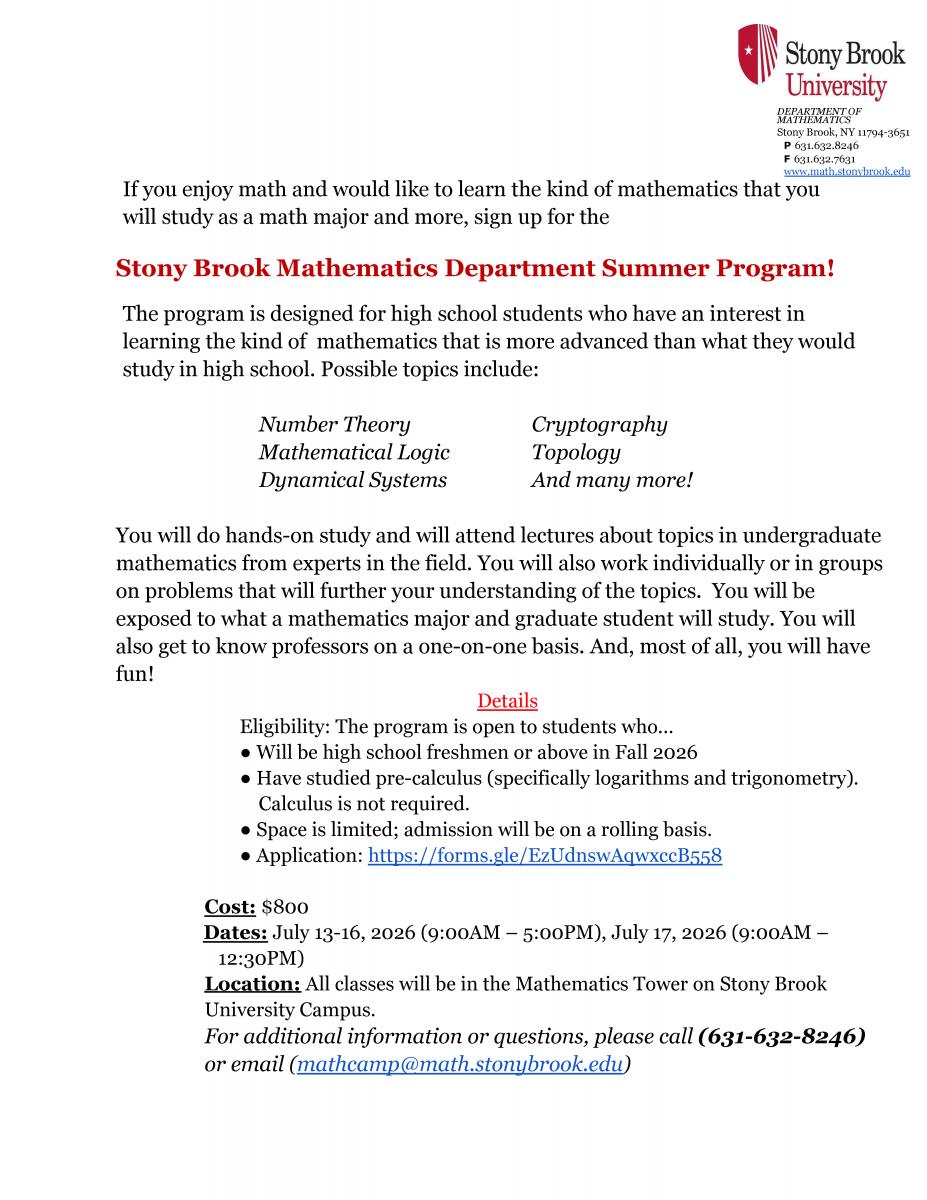
The Mathematics Department, housed within Stony Brook's College of Arts and Sciences, was founded in 1958 and in recent years has been consistently ranked among the top twenty-five departments in the country. Particular strengths include differential and symplectic geometry, algebraic geometry, algebraic topology, dynamics, complex analysis, and their applications to mathematical physics.
The Institute for Mathematical Sciences, founded in 1989, is closely allied to the department. The Institute's co-directors are John Milnor and Mikhail Lyubich. Its current primary research focus is on dynamical systems with an emphasis on the low-dimensional real and complex cases. The Institute is partially supported by the Simons Math-Physics Endowment.
The Institute and the Department have close ties to the neighboring Simons Center for Geometry and Physics, which focuses on the interface between mathematics and physics. SCGP permanent members Sir Simon Donaldson and Kenji Fukaya are members of the mathematics department faculty; there are many collaborative efforts, including seminars, colloquia, and afternoon tea.
The department offers a full range of undergraduate courses, with programs concentrating on pure mathematics or leading to preliminary certification to teach secondary school mathematics. On the graduate level there are Master's-level programs both for in-service and pre-service teachers and in pure mathematics. We have an active, high-caliber Ph.D. program in Mathematics, with over 66 students currently enrolled.