Study Guide: Quiz 9
Mathematics in China
Note: This is a study guide. The quiz will consist of three or four questions covering the material below. If you understand the ideas in the conceptual questions and can work through the short computations, you will be well prepared.
Note: Rod numerals will not be given if this problem is in the quiz.
Part 1: Quiz-Style Questions
Context, Rod Numerals and Counting Boards
- Who did mathematics professionally in ancient China, and for what purposes? Compare with Egypt, Babylonia, or the Greek world.
- Describe the rod numeral system. Is it additive, multiplicative, ciphered, or positional? How was zero represented?
- Why did the rods alternate between vertical and horizontal positions? Write 1705 in rod numerals.
The Book of Numbers and Computations and the Nine Chapters on the Mathematical Art
- What is the Nine Chapters on the Mathematical Art? Roughly when was it compiled, and what kind of mathematical text is it?
- How did the Book of Numbers and Computations reach us, and why does that matter? How were its problems and solutions presented?
- How did the Nine Chapters solve systems of linear equations (fangcheng)? Describe how the numbers were arranged and the main step of the method.
- Compare the Nine Chapters’ mathematical approach with Euclid’s Elements.
Liu Hui and computation of volumes
- Who was Liu Hui, and why is his commentary on the Nine Chapters important?
-
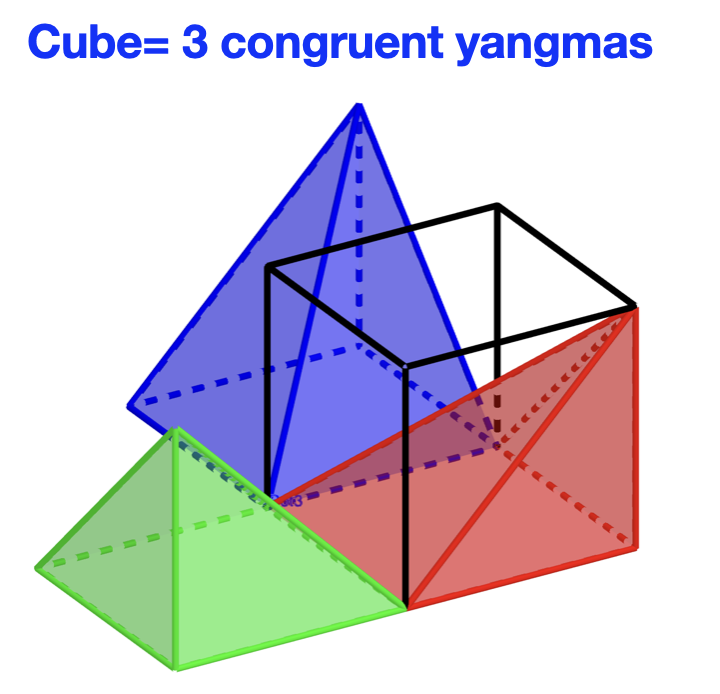
A cube can be cut into three congruent yangmas (pyramids with a rectangular base and one lateral edge perpendicular to the base, see figure), so each yangma is 1/3 of the cube. Why doesn’t this argument work for a rectangular prism that is not a cube?
-
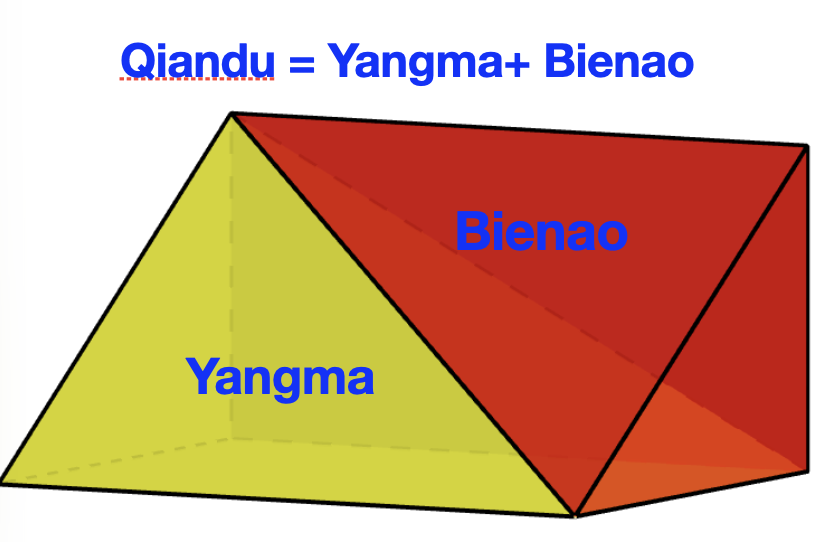
In Liu Hui’s argument for the volume of a yangma, a qiandu (half of a rectangular prism) is cut into a yangma and a bienao (see figure). He then cuts the yangma through the midpoints of its edges, obtaining a small rectangular prism, two small qiandus, and two smaller yangmas. He cuts the bienao similarly, obtaining two small qiandus and two smaller bienaos. The rectangular prism and qiandus from the yangma have exactly twice the volume of the qiandus from the bienao. The only pieces not yet accounted for are the smaller yangmas and bienaos, which Liu Hui cuts again by the same process, repeating indefinitely.
- What happens to the total volume of the pieces not yet accounted for as the process continues?
- What does this allow Liu Hui to conclude about the volumes of the yangma and the bienao?
- Why does this argument go beyond ordinary dissection?
- Describe the box-lid (mouhefanggai). What did Liu Hui show about the volumes of the sphere and the box-lid, and what was he unable to compute?
- How did Zu Gengzhi complete the argument?
- State the principle relating the volumes of two solids when their cross-sectional areas are equal at every corresponding height.
Gougu Theorem: Liu Hui’s Proof (Modern Reconstruction) (Not for Lecture 2)
The pieces of the squares on the two legs that stick out of the square on the hypotenuse can be rearranged to fill exactly, without gaps or overlaps, the parts of the square on the hypotenuse they don’t cover.
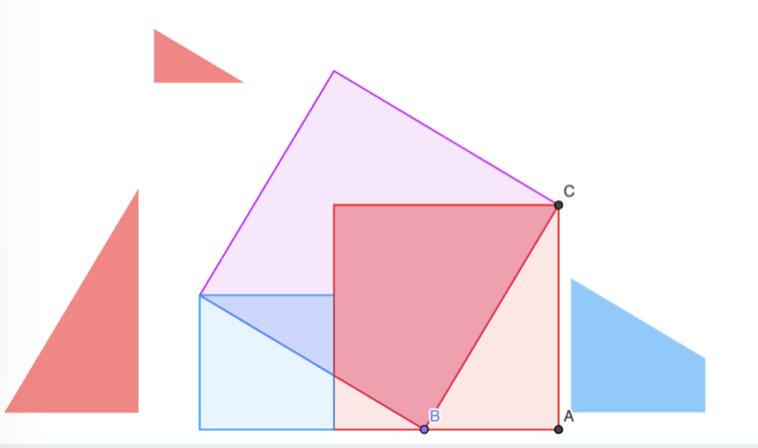
Purple: square on the hypotenuse. Red and blue: squares on the two legs. The loose pieces are the parts that stick out of the purple square; moved into the uncovered parts, they fill it exactly. Modern reconstruction; Liu Hui’s figure is lost. Move the pieces yourself in the GeoGebra applet.
- Why does rearranging these pieces show that the square on the hypotenuse has the same area as the two squares on the legs together?
- What must we know to conclude that this is a proof for all right triangles?
Computing π (Not for Lecture 2)
- Explain how Liu Hui used inscribed polygons to approximate π.
- Why does repeatedly doubling the number of sides improve the approximation?
- How did Liu Hui obtain both lower and upper bounds?
- How did his approach differ from Archimedes’ method?
Part 2: Reflection Questions
- The comparison between ancient Chinese elimination and modern matrices is tempting. What can such comparisons illuminate, and what can they distort?
- Joseph Dauben writes that Chinese mathematicians’ “proofs were not axiomatic proofs, but they were proofs nevertheless.” Do you agree? Use one argument from this unit in your answer.
Quiz Problem Rubric
| Points | Criteria |
|---|---|
| 3 | Correct answer with reasoning/work shown |
| 2 | Partially correct with some reasoning shown |
| 1 | Correct answer without reasoning/work OR significant attempt with some understanding |
| 0 | Incorrect or blank |
Notes
- For computational problems: “reasoning/work” = steps shown.
- For conceptual problems: “reasoning” = explanation given.
- Round partial credit up when in doubt.