Study Guide: Quiz 2
Number Systems
Note: This is a study guide. The quiz will consist of approximately four questions covering the material below. If you understand the ideas and facts in the non-computational questions and can work through the computational problems, you will be well prepared.
Numeral Charts: The numeral charts shown below will be provided with your quiz. You may refer to them when answering questions.
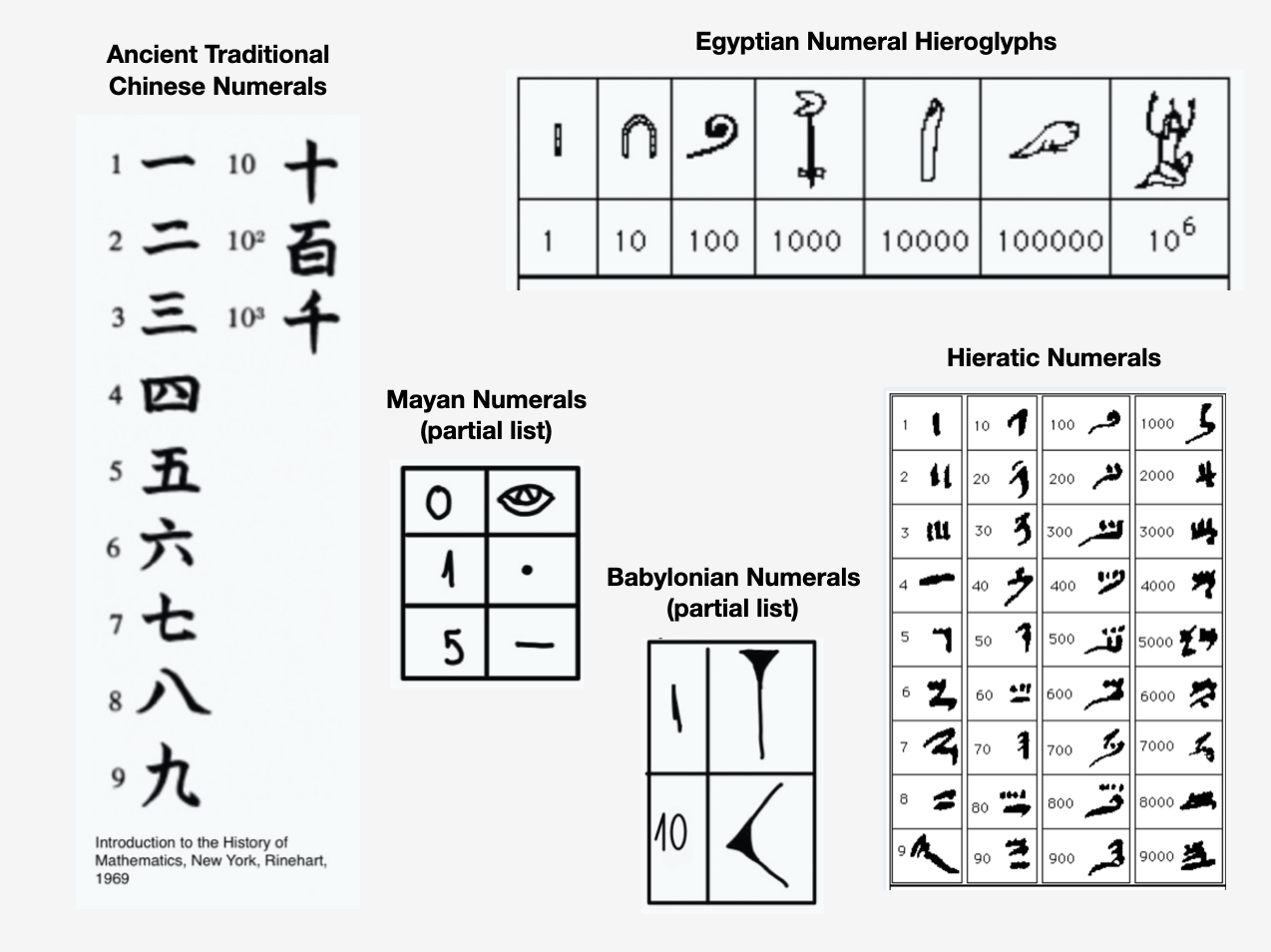
Charts showing Egyptian, Chinese, Mayan, Babylonian, Greek, and Hieratic numerals
Reading
Chapter 1 of the book "An introduction to the history of mathematics" by Howard Eves Print Book, English, (4th ed Holt, Rinehart and Winston, New York, 1976) has a good discussions about number systems. You can find it here. (This is a free Internet library, but you will need to create an account to read this book.)Quiz like questions
- What is the difference between a numeral and a number? Give an example of each one.
- What are the three components of a number system?
- What is an additive number system?
- What makes a number system positional?
- What are the two sets of numerals in a multiplicative system?
- Write 2,316 in Egyptian hieroglyphics.
- What number is represented by: [4 lotus flowers, 3 coiled ropes, 8 vertical strokes] in the Egyptian number system?
- What is the rule about repeating numerals in Egyptian hieroglyphics?
- Is the Greek alphabetic system positional? Why or why not?
- Write 462 in traditional Chinese.
- What type of system is traditional Chinese?
- State the Integer Division Theorem and find the quotient and remainder when 95 is divided by 12.
- Convert 386 to the Mayan number system. Mayan numbers are written vertically, from bottom to top, with the smallest place value at the bottom.
- Convert (3, 15, 8)₂₀ to base 10.
- Express 425 in the Babylonian number system. Babylonian numbers are written horizontally, from left to right, with the highest place value on the left. Is the Babylonian system positional? Give an example of how your representation of 425 reflects this characteristic.
- Is the Babylonian system positional?
- If we look only at Mayan and Babylonian numerals, without knowing how the full systems work, both may appear to be constructed in an additive way. What does “additive” mean here? Explain why the numerals have this appearance.
- (This question is too long for a quiz so a subset of its entries may be asked) Complete the comparison table for 936. Which number system uses the fewest numerals? Why? Is this characteristic specific to the number 936, or does it hold for other numbers?
System Representation # of numerals used Egyptian hieroglyphic Greek alphabetic Traditional Chinese Mayan (base 20) Hindu-Arabic Babylonian - Egypt used two different number systems: hieroglyphic (for stone monuments) and hieratic (for papyrus documents). Looking at the hieratic numerals, what type of system (additive, ciphered, multiplicative, positional) does it appear to be? Explain your reasoning.
- Can a system have multiple characteristics? If so, give an example; if not explain why.
- Is the Roman numeral system positional?
- Why did different civilizations develop different bases (10, 20, 60, etc.)?
- Why do positional systems need zero or something that plays the role of zero (like blank spaces in the Mesopotamian number system?
- Laplace was impressed by the Indian number system. What feature of our number system does he think is especially important?
- Laplace says this system made calculation easier. Can you think of one calculation that would be harder in Roman numerals?
- Was India the first culture to use a positional number system? What earlier example have we seen?
"The ingenious method of expressing every possible number using a set of ten symbols (each symbol having a place value and an absolute value) emerged in India. The idea seems so simple nowadays that its significance and profound importance is no longer appreciated. Its simplicity lies in the way it facilitated calculation and placed arithmetic foremost amongst useful inventions. The importance of this invention is more readily appreciated when one considers that it was beyond the two greatest men of Antiquity, Archimedes and Apollonius."
— Pierre-Simon Laplace, ~1800
Part 2: Reflection Questions
- Which of these systems would make arithmetic (addition, subtraction) easiest? Which would make it hardest? Explain your reasoning.
- Today we use one number system worldwide (Hindu-Arabic). What might we have lost when number systems were standardized? What did we gain?
Quiz Problem Rubric
| Points | Criteria |
|---|---|
| 3 | Correct answer with reasoning/work shown |
| 2 | Partially correct with some reasoning shown |
| 1 | Correct answer without reasoning/work OR significant attempt with some understanding |
| 0 | Incorrect or blank |
Notes
- For computational problems: "reasoning/work" = steps shown
- For conceptual problems: "reasoning" = explanation given
- Round partial credit up when in doubt