Study Guide: Quiz 11
Mathematics in the Islamic Golden Age
Note: This is a study guide. The quiz will consist of three or four questions covering the material below. If you understand the ideas and facts in the non-computational questions and can work through the computational problems, you will be well prepared.
Quiz-Style Questions
For problems 1–3: in the quiz you will be given the handout with al-Khwārizmī’s two demonstrations for “a square and ten roots equal thirty-nine” (the same text reproduced below on this page).
- Following al-Khwārizmī’s first demonstration (four rectangles), solve “a square and eight roots equal thirty-three.”
- Draw his figure for this problem, and label the width of each rectangle and the side of each corner square.
- What must be added to complete the large square? What is its total area?
- Find the side of the large square, and then x.
- Why does the second solution, x = −11, not appear in the figure?
- Following al-Khwārizmī’s second demonstration (two rectangles), solve “a square and six roots equal sixteen.”
- Draw his figure for this problem, and label the length of each rectangle and the side of the corner square.
- What must be added to complete the large square? What is its total area?
- Find the side of the large square, and then x.
- Why does the second solution, x = −8, not appear in the figure?
- With four rectangles, the four corner squares would add 4 × (6/4)². Check that this equals what you added in part b, and explain why the two methods always add the same amount.
- Following al-Khwārizmī’s method, consider “a square and b roots equal c dirhams,” where b and c are positive.
- Draw al-Khwārizmī’s figure with four rectangles. Label the sides in terms of x and b.
- What area must be added to complete the large square?
- Find the side length of the large square, then derive a formula for x in terms of b and c.
- Compare your formula with the quadratic formula. What happened to the other solution?
- Give the approximate dates of the period often called the Islamic Golden Age. Which dynasty came to power around 750, and which city became the main center of learning?
- What does “Islamic mathematics” refer to? Was it done only by Muslims? In what language was most of it written?
- Give two reasons why scholarship flourished in the Islamic world during this period.
- What was the House of Wisdom, and what activities are associated with it? What do historians still debate about it?
- Name three authors whose works were translated into Arabic, with one work by each. Were these works simply preserved? Explain.
- Name two mathematicians of the Islamic Golden Age, with approximate dates and one contribution each.
- Al-jabr (“restoration”) is the operation of eliminating a subtracted term from one side of an equation by adding it to both sides. It appears in the title of al-Khwārizmī’s book, Kitāb al-jabr wa’l-muqābala (Baghdad, ~825). Which modern mathematical word comes from al-jabr, and which from al-Khwārizmī’s name?
- Al-Khwārizmī classified six types of equations. List all six using his terminology, and write one example of each type in modern notation. Why did he need six different types?
- Why did al-Khwārizmī accept only positive solutions?
- Omar Khayyam wrote that his treatise would be understood only by readers who had mastered certain books. Which books? What does this reveal about how mathematical knowledge was organized and transmitted?
- How did Omar Khayyam solve cubic equations? Why did he need 19 different types?
- Why does an astrolabe need different plates for different latitudes, while the rotating star map remains the same?
- What is the perfect compass? Who described it, and approximately when? Explain the mathematical reason why it draws a conic section.
Reading al-Khwārizmī — Completing the Square
Read the following demonstration and work through the exercises.
Demonstration: “A Square and Ten Roots are Equal to Thirty-Nine Dirhams”
The figure that explains this problem is a square with unknown side length, representing the square whose root we wish to find. Call this square AB, where each side represents a root. Multiplying a side by a number gives a rectangle whose area represents that many roots. Since the roots are combined with the square in this problem, we take one-fourth of ten — that is, two and a half — and add it to each of the four sides.
We attach four rectangles to square AB, each having a side of AB as its length and two and a half as its width. These are rectangles C, G, T, and K. We now have a figure with equal (but unknown) sides, except that at each corner a small square of side two and a half is missing. To fill these gaps and complete the large square, we add four times the square of two and a half — that is, twenty-five.
We know from the problem that square AB together with the four rectangles (representing the ten roots) equals thirty-nine. Adding twenty-five (the four corner squares that complete the large figure DH) gives sixty-four. The side of this large square is its root: eight.
Subtracting twice two and a half — that is, five — from eight removes the added lengths from both ends of the side of DH. The remainder, three, is the root of the original square: the side of AB.
Note: We halved the number of roots and added the square of that half to thirty-nine in order to complete the four corners. This works because one-fourth of any number, squared and multiplied by four, equals the square of half that number. So we square half the roots directly, rather than squaring one-fourth and multiplying by four.
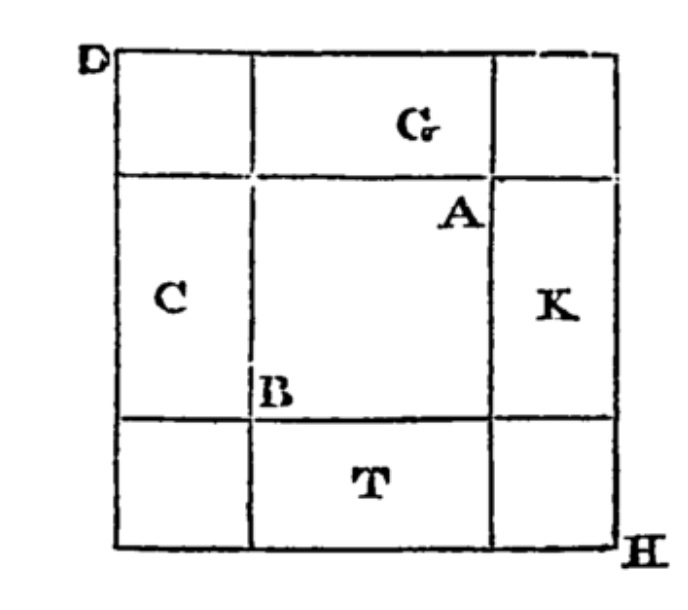
Square AB with rectangles C, G, T, K and completed large square DH
Exercises (First Method — Four Rectangles)
- Denote the side of AB by x, and find the area of one of the four attached rectangles (C, G, T, or K) in terms of x.
- Find the area of one corner square.
- Add the areas of the four corner squares to the areas of AB, C, G, T, and K to get the area of the large square DH.
- The original square AB plus the four rectangles equals 39. What is the total area of the completed large square DH?
- What is the side length of DH?
- What is x, the side length of the original square AB?
Second Method (Two Rectangles)
We again start with square AB. We halve the ten roots to get five, and attach two rectangles — G and D — to two sides of AB. Each rectangle has length five and width equal to a side of AB.
A square remains at the corner opposite AB, with side five (half the number of roots). The original square plus the two rectangles equals thirty-nine. To complete the large square SH, we add this corner square: five times five equals twenty-five. So the large square has area sixty-four, and side eight.
Subtracting five — the quantity we added — from eight gives three: the side of AB, the root we were seeking. The square itself is nine.
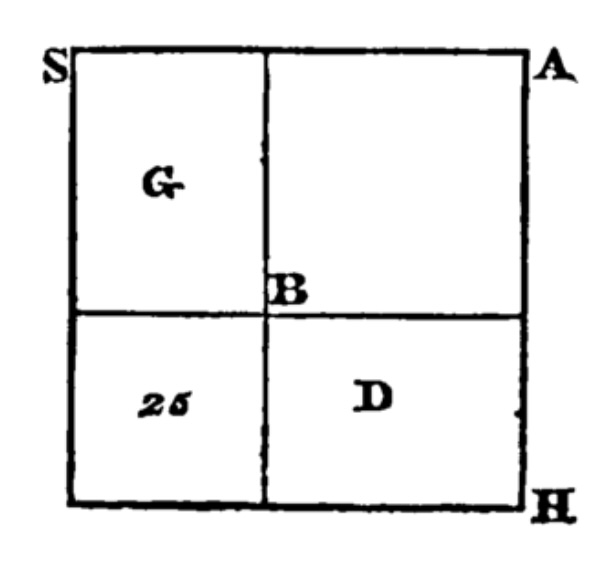
Square AB with rectangles G and D and completed large square SH
Exercises (Second Method — Two Rectangles)
- Denote the side of AB by x, and find the area of one of the two rectangles (G or D) in terms of x.
- Find the area of the corner square.
- Add the areas of AB, G, D, and the corner square to get the area of SH.
- The original square plus the two rectangles equals 39. Find the total area of SH in actual numbers.
- What is the side length of SH?
- What is x?
Reflection Questions
- Greek knowledge did not simply pass into the Islamic world unchanged — it was translated, debated, extended, and criticized. What does this suggest about how mathematical knowledge travels between cultures?
- Michael Atiyah called algebra “the Faustian offer” made to the geometer. Compare al-Khwārizmī’s figure for x² + 10x = 39 with the quadratic formula. What do you gain with the formula, and what do you lose?
- Al-Khwārizmī excluded negative solutions because a root had to be a length. How do mathematicians treat negative numbers today? What does this reveal about how meaning shapes mathematics?
- Compare Khayyam’s list of prerequisites with what a modern math textbook expects from its readers.
- The perfect compass appears again in Florence around 1500, in the work of della Volpaia and Leonardo. Was it rediscovered or transmitted? What kind of evidence would you need to decide?
Quiz Problem Rubric
| Points | Criteria |
|---|---|
| 3 | Correct answer with reasoning/work shown |
| 2 | Partially correct with some reasoning shown |
| 1 | Correct answer without reasoning/work OR significant attempt with some understanding |
| 0 | Incorrect or blank |
Notes
- For computational problems: “reasoning/work” = steps shown.
- For conceptual problems: “reasoning” = explanation given.
- Round partial credit up when in doubt.