Notes
- In order to get full credit in the open ended questions, you need to spend some time reflecting upon and writing your answers. In most of these problems, the probability that a one-sentence answer will get full credit is close to 0 (and so will be what you learn from the exercise)
- Make sure you show all your work on the problems that require it so. Otherwise, even if you give a correct answer, if you do not explain how you obtained it, you'll get very little or no credit.
- It would be great if you discussed ideas with your classmates. The write-up, however, must be done individually.
- Recall that the slides of the lectures can be found here.
- Follow the AI policy.
Problems
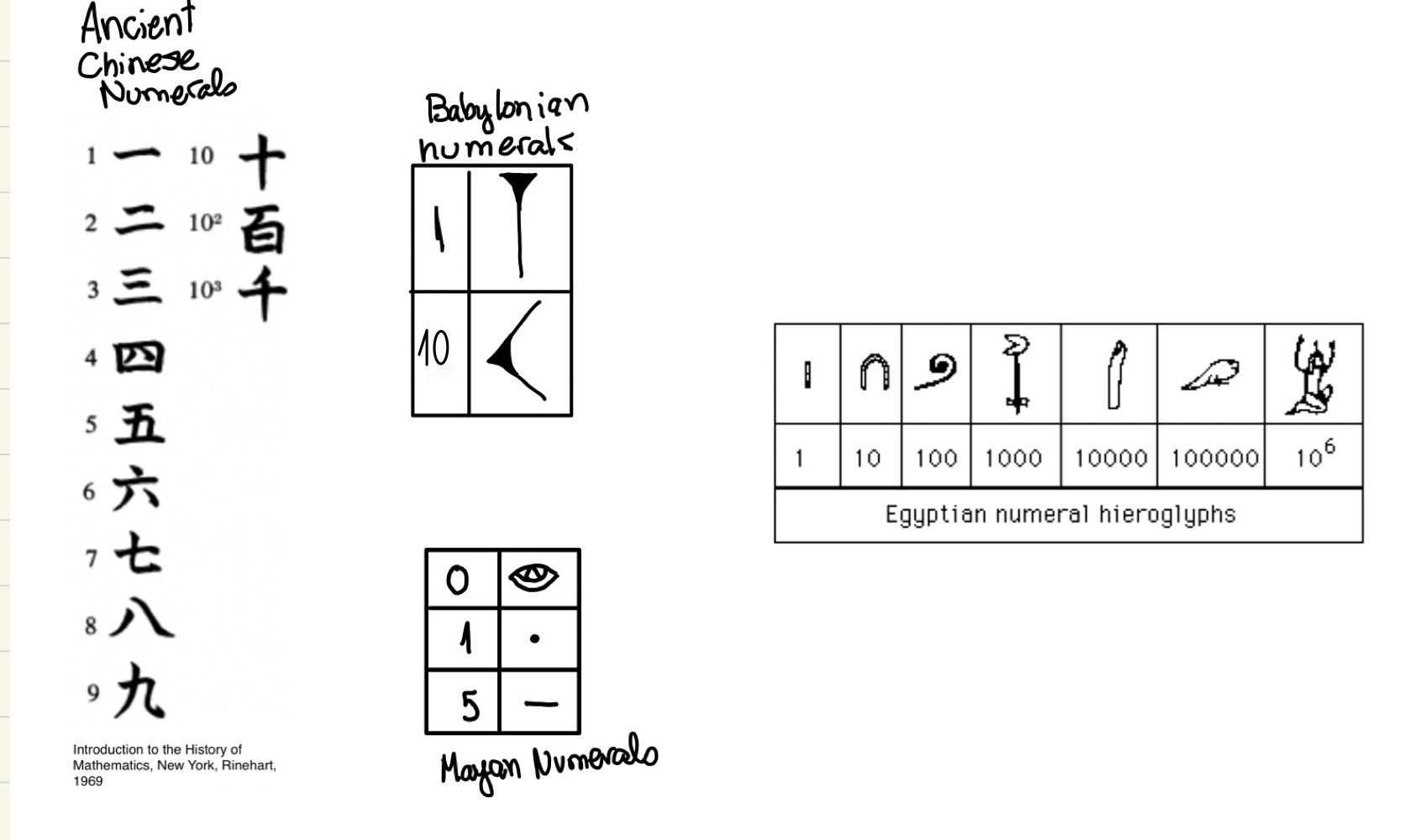
- Write 462 in the traditional Chinese number system.
- Write 55667 in the Mayan number system.
- Is the Greek alphabetic number system positional? Why or why not? (Notes: A yes or no answer, without explanation will get no credit. Here, the definition of positional is the one given in class.)
- Consider the number systems discussed in class
- Egyptian hieroglyphic
- Traditional Chinese
- Mayan
- Greek alphabetic
- Hindu Arabic
- Explain the difference between a number and a numeral. Give examples, if possible, of
- a number which is not a numeral.
- a numeral which is not a number.
- Why different societies ended up using number systems with different bases, how did their number system reflect how their society used numbers? What benefit comes from using different bases?
-
Find one peer-reviewed secondary source and one book related to your presentation and paper topic. It can be the one given on the course website if you are going to use in your presentation. Then complete the following:
- Topic
Write the title or focus of your presentation. - Complete bibliographical information
Include author, article title, journal name, volume/issue (if applicable), year, and page numbers. Editorial house for the book - Link to the article and/or book (if available)
Paste a direct link or a stable JSTOR, Project MUSE, or DOI link. It must be freely accessible or accessible through your Stony Brook account. - Answer in 3–4 sentences (maximum 100 words for each source):
- What is this source about?
- Why might it be useful for understanding your topic?
- How do you know it is peer-reviewed?
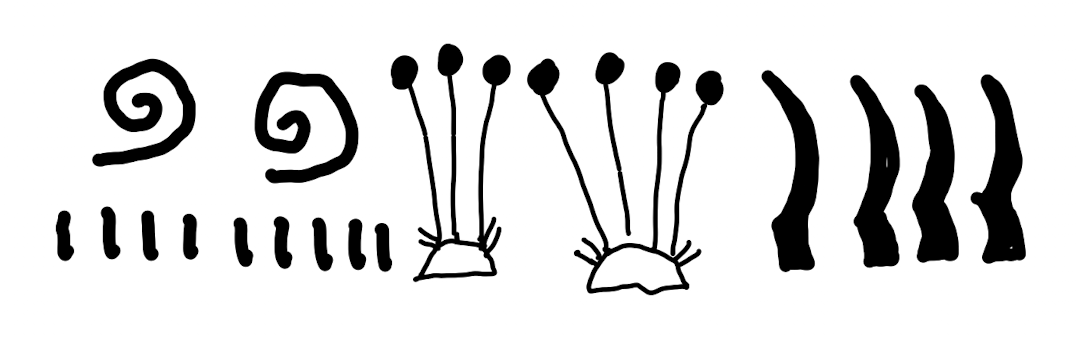
- The following is a paragraph from the book "The universal history of numbers", by Georges Ifrah, ``Another example of high numbers it is from a statue from Hieraconpolis, dating from 2800 BCE, where the number of enemies slain by a king called KhaSeKhem is shown as X by the following sign''. You need to find out X, that is the number of enemies slain from the hieroglyphic below. It will come handy to read how the book continues ``Early examples show rather irregular outlines and groupings of the signs.'' given that our example shows such an irregular grouping.
 Hieroglyphic inscription
Sample Quiz 1
- Write 346 in the traditional Chinese number system.
- Write 55667 in the Mesopotamian number system.
- Write in Hindu-Arabic numerals the number given in hieroglyphic above.
- Is the Greek alphabetic number system positional? Why or why not? (Notes: A yes or not answer, without explanation will get no credit. Here, the definition of positional is the one given in class.)
Note 1: The numerals in the table below will be given with the quiz.
Note 2: These four questions are chosen to give you an idea of the length of the test. The other problems of the homework are also possible questions (although 4 is a bit too long..)
- Topic