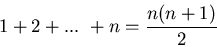
 for all
 .
A way to do so is
.
A way to do so is  and assume that for
 that either
  is true OR
  is true for all positive integers
  ,
,
 .
In case (a) the
argument is known as the principle of mathematical induction and in
case (b), as the principle of complete mathematical
induction. Mathematical induction and complete mathematical
induction are entirely equivalent. One uses the form most convenient for
problem at hand. Examples of formulae that can be so proven are: For each
,
(the sum of the first
.
In case (a) the
argument is known as the principle of mathematical induction and in
case (b), as the principle of complete mathematical
induction. Mathematical induction and complete mathematical
induction are entirely equivalent. One uses the form most convenient for
problem at hand. Examples of formulae that can be so proven are: For each
,
(the sum of the first  positive integers)
positive
integers)
positive integers)
positive
integers) 
![\begin{displaymath}1 + 2 + ... \ + n = [1 + n] + [2 + (n-1)] + [3 + (n-2)] + \ ... \ .\end{displaymath}](img99.gif)
 terms; each term equals
 .
Thus the sum is
.
Thus the sum is
 .
(Why don't we have a problem for
odd?) To prove the second formula by induction, we note that it
certainly is valid for
.
(Why don't we have a problem for
odd?) To prove the second formula by induction, we note that it
certainly is valid for  (substitution into both sides). Assuming the
formula for
(substitution into both sides). Assuming the
formula for
 tells us that


 .
Can you deduce and then prove the formula for the sum of the cubes of
the first
positive integers
.
Can you deduce and then prove the formula for the sum of the cubes of
the first
positive integers 
If you are interested in more information concerning mathematical proofs,
you might want to consult
1. G.R. Exener, An Accompaniment to Higher Mathematics, Springer, 1996.
or
2. Appendices A and B to: A. Mattuck, An Introduction to Analysis, Prentice
Hall, 1999.