Theorems (major results), propositions (not
so major results) and lemmas (minor
results needed to derive propositions or theorems) are deduced from
previously established theorems, propositions, lemmas and axioms (these are
assumed without proof). We will use several logical concepts. We
are usually trying to prove that  implies
  or to show that does not imply .
Here
and
are simple or complicated
mathematical statements or formulae. To show that
implies ,
we
have to prove that whenever
is true,
is also true. To show that
does not imply ,
we have to find one case where
is true and
is not. Thus to prove that ``every girl in New York City under the age
of 5 has green eyes'' we could collect all the girls in New York
City under the age of 5 in one room and look at the color of each girl's
eyes. If we found one girl with blue eyes, then we would have shown that the
statement ``every girl in New York City under the age of 5 has green eyes''
is false.
or to show that does not imply .
Here
and
are simple or complicated
mathematical statements or formulae. To show that
implies ,
we
have to prove that whenever
is true,
is also true. To show that
does not imply ,
we have to find one case where
is true and
is not. Thus to prove that ``every girl in New York City under the age
of 5 has green eyes'' we could collect all the girls in New York
City under the age of 5 in one room and look at the color of each girl's
eyes. If we found one girl with blue eyes, then we would have shown that the
statement ``every girl in New York City under the age of 5 has green eyes''
is false.
To facilitate communication we use a number of symbols (
 ,
,
 ,
,
 )
and give very specific meaning to
some English phrases. The symbols ``
)
and give very specific meaning to
some English phrases. The symbols ``
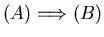 '' and ``
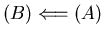 '' mean ``
implies '' and ``
is implied by
,'' respectively, and are logically equivalent. Four other sentences
that mean the same thing are:
'' mean ``
implies '' and ``
is implied by
,'' respectively, and are logically equivalent. Four other sentences
that mean the same thing are:
1.
if .
2.
only if .
3.
is sufficient for .
4.
is necessary for .
Implication is transitive; that is, if
and
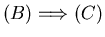 ,
then
,
then
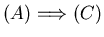 .
Every implication
(for example,
)
has a converse obtained by
interchanging the hypothesis and conclusion (in our example,
.
Every implication
(for example,
)
has a converse obtained by
interchanging the hypothesis and conclusion (in our example,
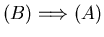 )
and a counterpositive (
)
and a counterpositive (
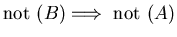 )
obtained by replacing the hypothesis with
the negation of the conclusion and the conclusion with the negation of the
hypothesis. An implication and its converse need NOT have the same truth
value, but an implication and its counterpositive always do. Try it with the
statement ``every girl in New York City under the age of 5 has green eyes.''
)
obtained by replacing the hypothesis with
the negation of the conclusion and the conclusion with the negation of the
hypothesis. An implication and its converse need NOT have the same truth
value, but an implication and its counterpositive always do. Try it with the
statement ``every girl in New York City under the age of 5 has green eyes.''
The symbol
is a combination of
and
and denotes implication in both directions. Thus ``
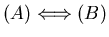 '' stands for ``
if and only if '' which we
shall also write as ``
iff .''
'' stands for ``
if and only if '' which we
shall also write as ``
iff .''