
 is a rule
 a value
 .
The set
.
The set  is the domain of the function ;
the set
is the domain of the function ;
the set  ,
its target. The
range of
is the set
,
its target. The
range of
is the set 
 ,
then the preimage of
,
then the preimage of  is defined
by
is defined
by 
 ,
,

 ,
,




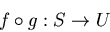
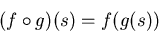
 are used with two different meanings in the above
equation). If the target space
has more structure, for example, if it is
are used with two different meanings in the above
equation). If the target space
has more structure, for example, if it is
 ,
,
 ,
,
 or
or
 ,
then we can define other operations on
functions. If, in these cases,
,
then we can define other operations on
functions. If, in these cases, 
 and
and  by the rules
 ;
this is possible if the target space allows
division as an operation (thus in case
;
this is possible if the target space allows
division as an operation (thus in case
 ,
or
), but we must
be careful not to divide by
,
or
), but we must
be careful not to divide by  .
The domain of definition for
is thus
.
The domain of definition for
is thus
 .
.